
The Philippine education system is at a turning point as it begins the transition into the Quality Basic Education Development Plan (Q-BEDP) 2025-2035. This 10-year strategy seeks to reverse a downward trend in learning outcomes that became more marked after the global pandemic. Data from the World Bank and the Second Congressional Commission on Education (EDCOM II) indicate that the country faces a severe learning crisis. For instance, 91% of ten-year-old children were found unable to read and understand short, age-appropriate text. This condition is linked to a quality-deprived system that remains overly centralized and lacks the resources to meet the needs of over 27 million learners.
To address these systemic failings, the Department of Education (DepEd) has launched the MATATAG Curriculum, which focuses on de-congesting the academic workload and prioritizing foundational skills in literacy and numeracy. As teachers move into this new instructional framework, they require digital tools that align with these goals without adding to their administrative burdens. ZEP QUIZ, a metaverse-based assessment platform, presents an opportunity to bridge the engagement gap while supporting the requirements of the updated curriculum.
Table of Contents
The state of Philippine basic education in 2025
Recent international assessments, such as the 2018 and 2022 Programme for International Student Assessment (PISA), have placed the Philippines near the bottom of participating nations. In 2018, the country ranked last among 78 countries, and in 2022, it placed 77th out of 81. These results reflect a system where 72% of students are categorized as low achievers. The Q-BEDP 2025-2035 identifies Outcome 4—improving education quality through an upgraded curriculum and digitally enabled schools—as an essential objective to improve these rankings.
One of the primary obstacles to quality instruction is the heavy workload of educators. Public school teachers currently manage roughly 50 non-teaching or administrative tasks, including managing school canteens and entering data into reporting systems. Research indicates that some teachers spend approximately 70 out of 220 school days on data entry rather than active instruction. This creates a need for tools that simplify preparation and automate assessment.
Introducing ZEP QUIZ as a strategic solution
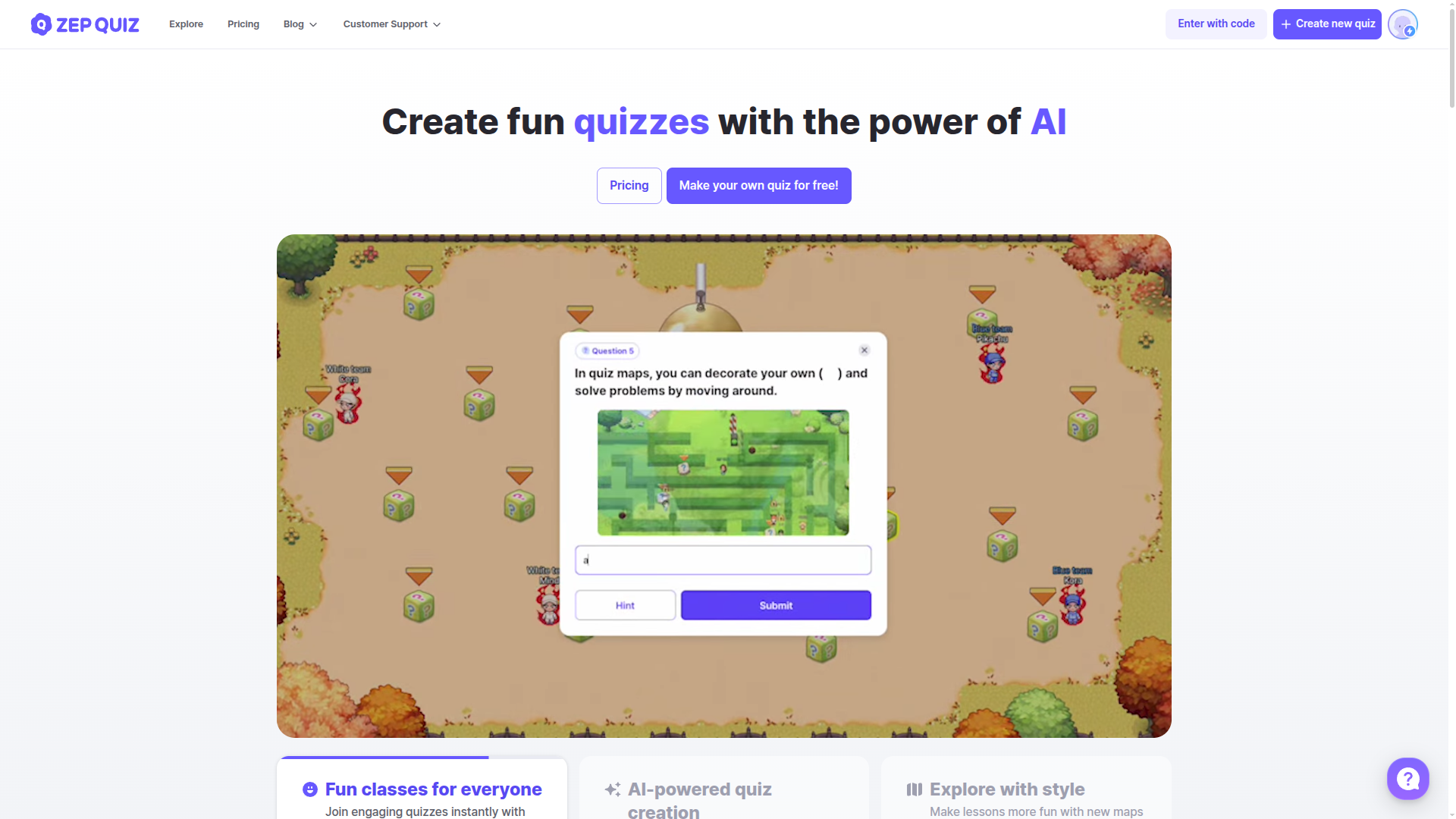
ZEP QUIZ is a South Korean educational technology platform that replaces static, text-heavy quiz interfaces with a 2D pixel-art metaverse. In this virtual environment, students control customizable avatars and explore themed maps such as “Undersea Cave Escape,” “Starlit Christmas,” “Sky Temple,” and “Dungeon Escape.” Unlike traditional tools that rely on clicking buttons on a screen, ZEP QUIZ uses spatial engagement where students move their avatars to physical locations on the map to answer questions.
As of January 2026, ZEP QUIZ has grown to serve 19.47 million users globally, demonstrating its rapid adoption across Southeast Asia and beyond:
| Region | Users |
|---|---|
| Indonesia | 6.69 million |
| South Korea | 5.89 million |
| Thailand | 5.56 million |
| United States | 145,000 (rapidly growing strategic market) |
| Philippines | 142,000 (currently a key focus market) |
🎮 Try ZEP QUIZ Now! Experience the metaverse quiz platform yourself — no account needed.
▶ Play a Sample Quiz Map Instantly →
This regional distribution highlights the platform’s strong traction in ASEAN countries, where educational challenges and infrastructure conditions are similar to the Philippines. The growing Philippine user base represents an emerging community of educators already exploring the platform’s potential.
The platform offers four distinct map types to accommodate different instructional goals. Sequencing maps require students to solve problems in a given order, mimicking quest-based progression. Freestyle maps allow students to explore and find hidden problems in any order, creating a treasure-hunt experience. Team Play maps divide participants into competing teams that collaborate to solve more problems within a time limit. Round Mode maps feature synchronized problem-solving where everyone answers the same question simultaneously, racing to be first with the correct answer.
This platform is uniquely suited for the Philippine context because it offers a Free plan that supports up to 200 concurrent participants. Most existing platforms limit free sessions to 40 or 50 players, which is insufficient for public school teachers who often combine sections for review. The ability to host an entire grade level in one virtual room without a subscription fee addresses the fiscal constraints identified in the EDCOM II reports.
Alignment with the MATATAG curriculum reforms
The MATATAG curriculum emphasizes a 70% reduction in learning competencies to focus on depth rather than breadth. ZEP QUIZ supports this shift by allowing for repeated, gamified practice of foundational concepts. For subjects in Key Stage 1, such as the “Makabansa” pillar, the platform provides the high stimulation required to maintain the attention of younger learners.
Furthermore, the curriculum mandates the integration of digital literacy as a competency. By navigating an avatar and interacting in a shared virtual space, students practice responsible digital citizenship. The platform acts as a sandbox for digital social skills, requiring students to move through the environment, respect the virtual space of others, and engage in real-time communication. This aligns with the MATATAG goal of producing future-ready citizens who are comfortable in digital environments.
Supporting the overworked teacher workforce
To help teachers reclaim their instructional time, ZEP QUIZ includes artificial intelligence features designed to automate test construction. The platform’s AI can generate questions in two primary ways: teachers can enter a topic directly and specify the number of questions, question type, and difficulty level; alternatively, they can upload learning materials in PDF, CSV, TXT, DOCX, PPT, or HWP format (up to 30MB), and the AI will analyze the content to generate questions automatically.
According to teacher testimonials featured on the ZEP QUIZ website, this AI-powered question generation can produce quizzes in under three minutes. The platform supports generating up to 100 questions per session, with options for multiple-choice, short-answer, and true/false (O/X) question formats.
This feature helps address the problem of “incomplete teaching and learning resources” highlighted by EDCOM II. In Year One of the EDCOM II review, it was found that only 27 textbooks had been successfully procured for Grade 1 to Grade 10 since 2012. Because textbooks are often unavailable, teachers are frequently forced to curate their own materials at their own expense. ZEP QUIZ aids this process by turning existing digital modules into interactive assessments quickly, allowing educators to focus on remediation rather than manual question preparation.
Research evidence on gamified spatial learning
While Philippine-specific research on ZEP QUIZ is still emerging, studies from Southeast Asian contexts demonstrate promising outcomes for gamified spatial learning platforms. A classroom action research study conducted at UPT SD Negeri 99 Suppa in Pinrang Regency, Indonesia, published in the Journal of Education and Computer Applications (November 2025), examined the integration of ZEP QUIZ into Integrated Science and Social Studies (IPAS) instruction for Grade 4 students. The study, conducted over three cycles with 23 students, measured improvements in critical thinking skills:
| Cycle | Mastery Level | Average Score |
|---|---|---|
| Pre-Cycle | 39.13% | 60.43 |
| Cycle I | 56.52% | 68.26 |
| Cycle II | 78.26% | 77.04 |
| Cycle III | 91.30% | 86.09 |
The pre-cycle data represents baseline performance before the ZEP QUIZ intervention was introduced, highlighting the significant improvement achieved through the platform. The researchers found that teacher and student activities showed progressive improvement, moving from “fair” to “very good” categories across the cycles. They concluded that the integration of ZEP QUIZ effectively enhances students’ critical thinking skills by fostering interactive, engaging, and motivating learning experiences that encourage active participation and deeper cognitive processing.
A separate study at SMA Negeri 3 Palembang, also in Indonesia, examined ZEP QUIZ’s impact on learning motivation in Pancasila Education (Civics). Published in Jurnal Profesi Pendidikan (June 2025), this classroom action research with 37 Grade 11 students showed motivation levels increasing from 43% in the pre-cycle to 68% in Cycle I, and reaching 88% in Cycle II—a “Very Good” category. The researchers noted that students initially found traditional learning monotonous, but the gamified approach significantly increased engagement.
These Indonesian studies provide a research foundation that Philippine educators can build upon, given the similar educational contexts and challenges faced by both countries in the ASEAN region.
Addressing the digital divide and infrastructure gaps
While the Q-BEDP 2025-2035 aims for “digitally enabled schools,” the current reality of the Philippines includes significant infrastructure deficits. There are 12,532 schools that lack internet and electricity, and 9,535 schools that lack computers. ZEP QUIZ addresses these challenges through its browser-based design, which requires no software installation or app downloads. Students can access quizzes directly through a shared link without logging in, making participation possible even on basic smartphones.
However, the platform requires stable internet connectivity for real-time avatar synchronization. It is best used in environments with stable connections, such as computer labs. To help manage bandwidth in schools with limited connectivity, teachers can use collaborative modes where three students share one device. This reduces the network load while encouraging collaboration and social negotiation of answers. For remote or “Last Mile” schools, adoption should wait for the rollout of satellite internet projects, such as Starlink, as promised in recent government public-private partnership (PPP) initiatives.
For schools with restrictive network policies, ICT coordinators should whitelist the following domains to ensure proper functionality: *.zep.us and *.weegloo.com. The recommended network speed is 80Mbps or higher for optimal performance.
Comparative analysis of education technology tools
Teachers in the Philippines have reported experiencing “quiz fatigue” with traditional platforms that have remained unchanged for years. ZEP QUIZ offers a different paradigm compared to the established giants in the market.
| Feature | ZEP QUIZ | Kahoot! | Quizizz |
|---|---|---|---|
| Primary Paradigm | Metaverse (Spatial) | Game Show (Host-led) | Gamified Quiz (Self-paced) |
| Engagement | Kinesthetic/Social | Visual/Speed | Individual/Rewards |
| Free Player Limit | 200 Students | Variable (~40) | Unlimited (Basic) |
| AI Generation | Yes (Topic & File) | Paid Add-on | Yes |
| Map Variety | 25+ themed maps | Standard interface | Standard interface |
| Integration | Google Classroom | Google/Microsoft | Google/Microsoft/LMS |
| Filipino Language Support | AI Translation Available | Limited | Limited |
ZEP QUIZ stands out due to its generous Free tier and the immersive nature of its maps, which prevents student fatigue by offering variety in visual assets and spatial constraints. New maps are added monthly, including seasonal themes like “Starlit Christmas” and genre-based options like “Dungeon Escape” and “Zombie vs Researcher.”
ZEP QUIZ Plan Comparison
While the Free plan provides substantial functionality, ZEP QUIZ offers Basic and Pro subscription tiers for teachers requiring advanced features.
Plan Comparison
| Feature | Free | Basic | Pro (Recommended) |
|---|---|---|---|
| Monthly Price (USD) | $0 | $9.99 (Early Bird -33% off $15) | $24.99 (Early Bird -29% off $35) |
| Target User | Individuals starting with basic features. | Teachers needing basic maps and AI features. | Teachers needing unlimited maps and advanced AI. |
| Concurrent Users | Up to 200 users | Up to 200 users | Up to 200 users |
| Maps Access | Free maps (Limited availability) | Basic maps | Unlimited access to all maps |
| Quiz Privacy | Public quizzes only | Private & Public quizzes | Private & Public quizzes |
| Save Worksheet | ❌ | ❌ | ✅ |
| Continue to next quiz | ❌ | ❌ | ✅ |
| Progress Reporting (LMS) | |||
| – Student statistics | Limited (Basic) | ✅ | ✅ |
| – Question statistics | ❌ | ❌ | ✅ |
| – Overall statistics | ❌ | ❌ | ✅ |
| QUIZ AI | |||
| – Enter topic manually | ❌ | ✅ | ✅ |
| – Extract from files | ❌ | ✅ | ✅ |
| – Extract from YouTube | ❌ | ✅ | ✅ |
| – Create similar questions | ❌ | ❌ | ✅ |
| – Generate options & answers | ❌ | ❌ | ✅ |
| – AI question translation | ❌ | ❌ | ✅ |
Plan Summaries
- Free Plan: Includes basic features, access to 3.7M+ existing quizzes, and allows for up to 200 concurrent users with public quizzes and free maps.
- Basic Plan: Adds the ability to create private quizzes, access to basic maps, and core “Quiz AI” features like generating questions from manual topics, files, or YouTube videos.
- Pro Plan: The “Recommended” plan that includes everything from Basic plus unlimited map access, full progress reporting (LMS) features, worksheet saving, and “Enhanced Quiz AI+” (similar question generation, automated options/answers, and AI translation).
The AI translation feature in the Pro plan is particularly relevant for the Philippine context, where instruction may occur in Filipino, English, or regional languages. Teachers can enable real-time translation of quiz content, allowing students to select their preferred language while solving problems.
Financial sustainability and adoption models
Financing for education in the Philippines has increased from 3.58% of the GDP to a proposed 16.0% of the national budget in 2024. However, the cumulative spending per student remains at USD 11,000 (PPP), which is well below the OECD average of USD 50,000. In this resource-strapped environment, the zero-cost entry point for ZEP QUIZ is its most significant motivator for adoption in public schools.
For private elite schools, which often have 1:1 student-device ratios and high-speed fiber internet, ZEP QUIZ can be used as a primary synchronous engagement tool with an adoption potential of 95%. For urban public secondary schools, where 30 to 50 students may share one computer, a model involving lab-based rotations or shared device groups is more sustainable.
Specific insights for implementation
Adopting ZEP QUIZ is not merely a technical change but a shift in how assessment is perceived in the classroom. To ensure successful integration, schools must perform a “Connectivity Audit” before training teachers. It is essential that school ICT coordinators whitelist specific domains—*.zep.us and *.weegloo.com—to prevent the pixel-art maps and avatars from being blocked by school firewalls.
Teachers can leverage several classroom management features built into the platform. The “Start Together” feature ensures all students begin simultaneously, addressing the problem of staggered entries. Teachers can close the waiting room to prevent students from leaving prematurely, and a “Freeze Mode” allows teachers to pause all avatar movement when direct instruction is needed. For Team Play and Round Mode maps, the teacher must be present in the virtual room to start the game.
For subjects taught in Filipino or regional languages, teachers have two options: they can manually create content using the quiz builder, or Pro plan subscribers can use the AI translation feature to convert English-language quizzes into Filipino. DepEd regions can support localization by encouraging a “Bayanihan” approach, where teachers share their manually created Filipino quiz libraries through the platform’s public features, creating a shared repository of localized content. This cooperative model ensures that the transition to digital tools respects the linguistic diversity of the country while helping the basic education system meet its 2035 targets for learner proficiency.
Getting started with ZEP QUIZ
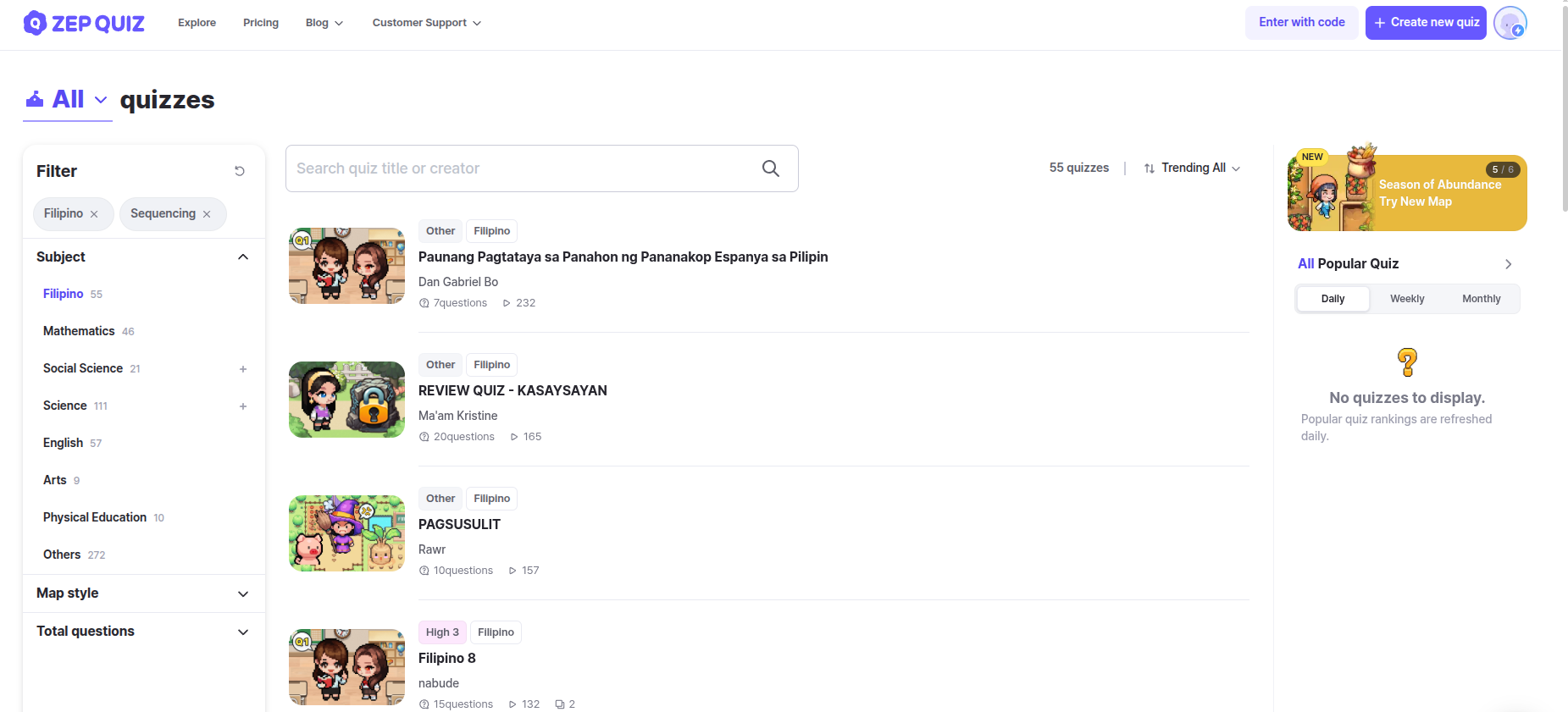
Teachers interested in adopting ZEP QUIZ can begin with these steps:
- Visit quiz.zep.us and log in using a Google account
- Select “Teacher” as the account type during initial setup
- Explore the public quiz library to find existing content by subject and grade level
- Copy and customize quizzes from other teachers to save preparation time
- Share quizzes with students via QR code, entry code, or direct link—no student login required
- Monitor student progress through the Learning Report feature
The platform’s Google Classroom integration allows teachers to assign quizzes directly as class assignments, with automatic result recording for easier grade management.
Become a ZEP QUIZ Global Ambassador
For educators who want to take their advocacy further, the ZEP QUIZ Global Ambassador Program offers an opportunity to lead, engage, and inspire learning across the Philippines. Ambassadors receive exclusive benefits including:
- Free Pro Plan access valued at $420/year (approximately ₱24,828)
- Official Ambassador Badge and custom Avatar Kit
- Priority access to new features and promotional opportunities
- Certificate of Completion for professional development portfolios
Ambassadors can choose from three activity tracks: content creation (2 videos/month), offline training sessions (1/month with 10+ teachers), or webinars (1/month with 20+ teachers, including a free ZEP Space venue worth $1,050).
Interested educators can apply at quiz.zep.us or contact biz@zep.us for more information. Read the complete guide to the ZEP QUIZ Global Ambassador Program →
As Philippine education continues its reform journey toward 2035, tools like ZEP QUIZ offer a practical bridge between traditional instruction and the digitally enabled future envisioned in the Q-BEDP. By combining engagement, accessibility, and AI-powered efficiency, the platform addresses multiple pain points in the current system while remaining fiscally viable for resource-constrained schools.
Get Started with ZEP QUIZ:
